
Concrete Monopile Technology for Offshore Wind
A concrete monopile foundation designed to reduce steel dependency while maintaining compatibility with existing offshore installation methods
Why Conventional Steel Monopiles Are Reaching Their Limits

Depth & Scale Constraints
As water depths increase and turbines grow larger, steel monopiles become significantly heavier, larger in diameter, and more challenging to manufacture, transport, and install efficiently.Escalating Project Costs
Rising steel prices, fabrication complexity, specialized vessel requirements, and offshore installation costs continue to increase overall foundation expenditure and project risk.
High Lifecycle Carbon Impact
The production, fabrication, transportation, and long-term maintenance of large steel foundations contribute substantially to embodied carbon and lifecycle emissions.
Corrosion & Long-Term Durability
Continuous exposure to harsh marine environments accelerates corrosion and fatigue loading, increasing inspection, protection, and maintenance requirements throughout the asset lifecycle.
Supply Chain & Industrialization Challenges
Increasing monopile dimensions are placing growing pressure on global steel supply chains,fabrication capacity, port infrastructure, and installation vessel availability — creating bottlenecks for future offshore wind deployment.
Industrialized Concrete Monopile Foundation Solution
CMC’s reinforced-concrete monopile concept addresses the key limitations of conventional steel monopiles while maintaining compatibility with established offshore wind design, transport, and installation practices.
By combining familiar monopile geometry with an industrialized reinforced-concrete structural system, CMC delivers a foundation solution designed for deeper waters, reduced steel dependency, lower lifecycle carbon impact, improved durability, and scalable production.

Deeper water capability
Water depths beyond 60 m. Diameters beyond 12 m.

Reduced CO2 footprint

Lower foundation cost

Improved corrosion resistance

Same mass & stiffness
The same mass and stiffness specifications as traditional solutions, ensuring reliable structural integrity

Existing installation methods
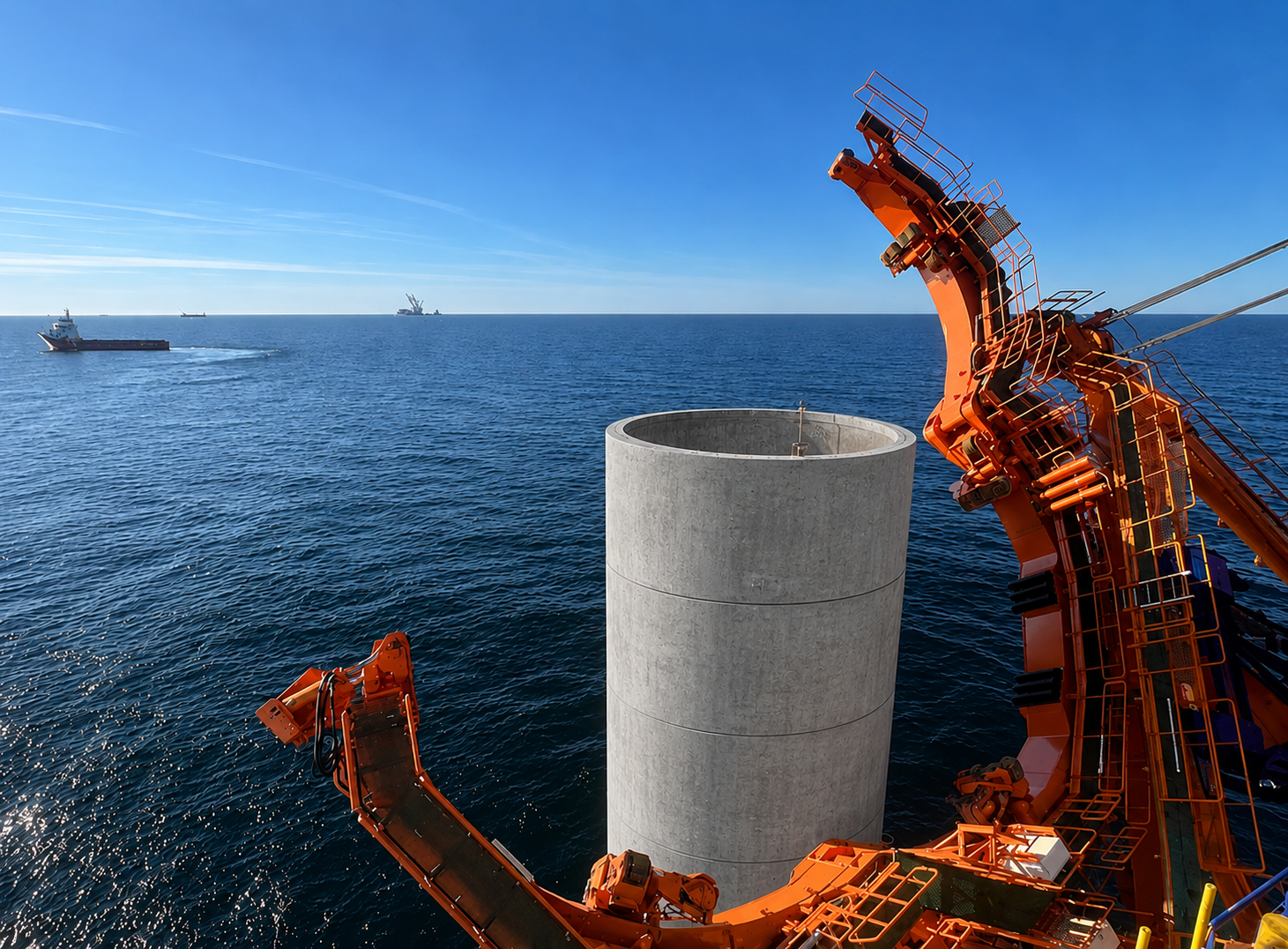
Maintains the same external diameter and a familiar form factor—supporting compatibility with established handling, transport, and installation equipment.
How Concrete Monopile Foundations Are Manufactured
CMC concrete monopile foundations are manufactured through a project-specific production model designed for offshore wind projects. The approach leverages regional supply chains, local materials, and scalable precast concrete manufacturing capabilities.
Once production facilities and mould systems are established, the foundation is manufactured through a modular three-step process.
Casting of Concrete Rings
Production begins with the controlled casting of Ultra-High Performance Concrete (UHPC) into modular precast ring segments.
This modular approach enables scalable manufacturing at local production sites or regional precast facilities, reducing transportation constraints while supporting local content and supply chain flexibility.
Assembly into a Tubular Monopile
The precast concrete rings are precisely aligned and assembled to form a continuous tubular monopile structure.
The modular configuration enables highly flexible foundation geometries, supporting very large diameters and extended pile lengths while simplifying manufacturing and logistics.
Post-Tensioning
Once assembled, high-strength post-tensioning cables are tensioned through the structure to connect the individual concrete segments into a single integrated monopile foundation.
The post-tensioning system provides the required structural capacity and stiffness while enhancing durability and long-term structural performance in harsh marine environments.


Scalable Manufacturing for Offshore Wind Foundations
Considerations for Offshore Wind Developers
Introducing new foundation technologies in offshore wind requires a careful balance between innovation, cost reduction, and project bankability.
CMC’s concrete monopile concept is specifically designed to minimize disruption to established offshore wind development, fabrication, transport, and installation workflows while addressing the growing need for lower costs, reduced carbon impact, and improved supply chain resilience.
By retaining the familiar monopile form factor and compatibility with existing project execution strategies, offshore wind developers can unlock significant value across cost, sustainability, and local manufacturing opportunities — without fundamentally changing turbine integration, marine operations, or project delivery models.
CMC enables a lower-cost, lower-carbon foundation pathway while preserving the familiarity, scalability, and bankability of the conventional monopile approach.
Fabrication Using Established Precast Concrete Methods
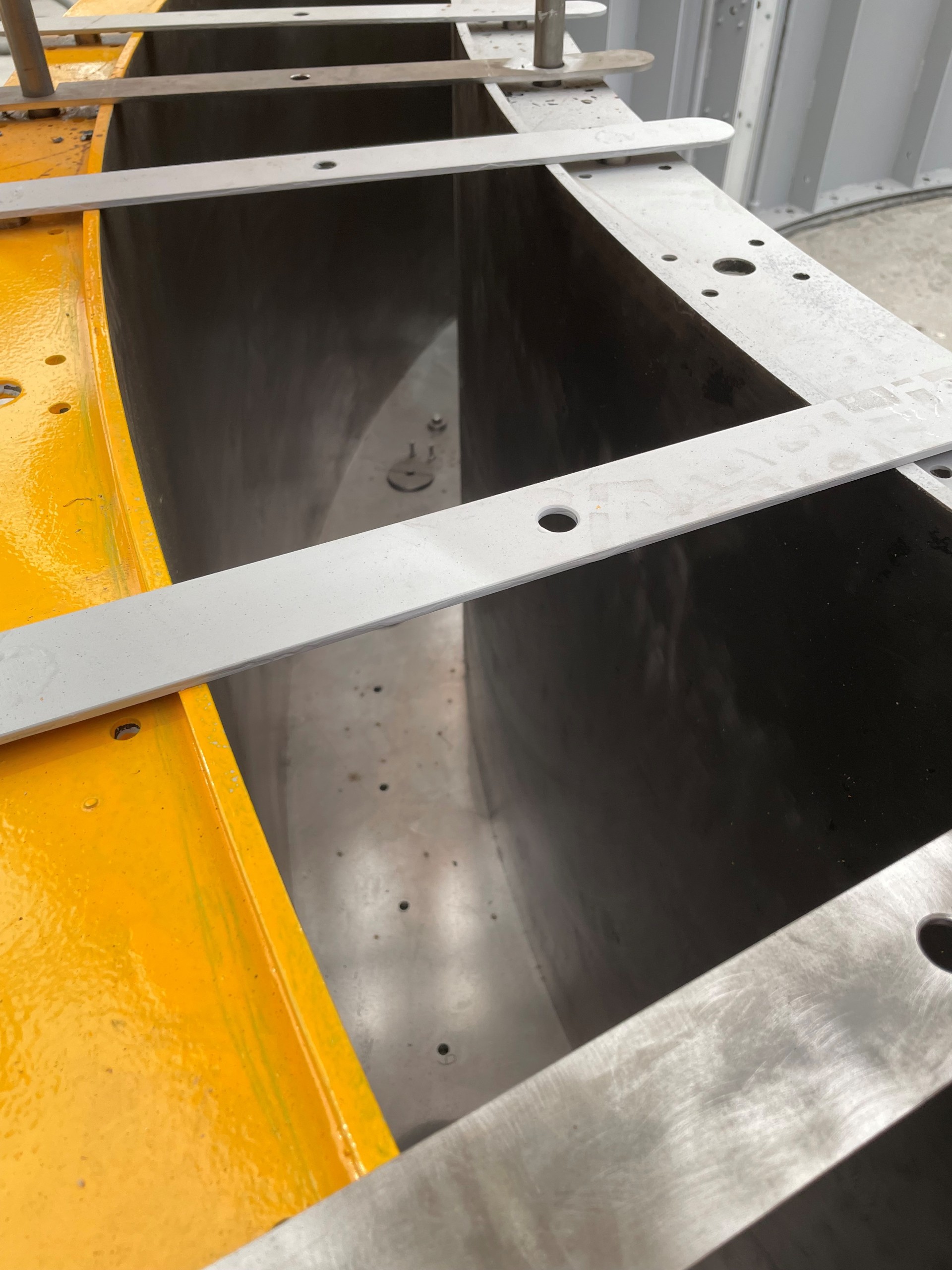
The fabrication process is based on proven methodologies widely used throughout the civil construction and precast concrete industries. The monopile foundation is manufactured through the casting of modular ring segments using Ultra-High Performance Concrete (UHPC).
The modular production approach enables scalable manufacturing, flexible production setup, and the use of regional supply chains and local materials where appropriate.


Compatible with Existing Offshore Wind Supply Chains
Unlike many emerging foundation concepts, the CMC concrete monopile is designed to fit within existing fabrication, transportation, installation, maintenance, and decommissioning workflows. This minimizes project disruption while enabling lower costs, reduced carbon emissions, and greater supply chain flexibility.